


A panel at the Enugu Gaming Conference 2026 (#EGC2026) has challenged Nigeria’s betting and gaming industry to confront a fundamental question: how much of the technology powering the sector is actually Nigerian-owned?
The discussion, titled “Building the Stack: Can Nigeria Own its iGaming Technology?”, brought together operators, developers and risk specialists to examine whether local companies can move beyond the customer-facing layer of iGaming and take ownership of the deeper technology infrastructure that supports the industry.
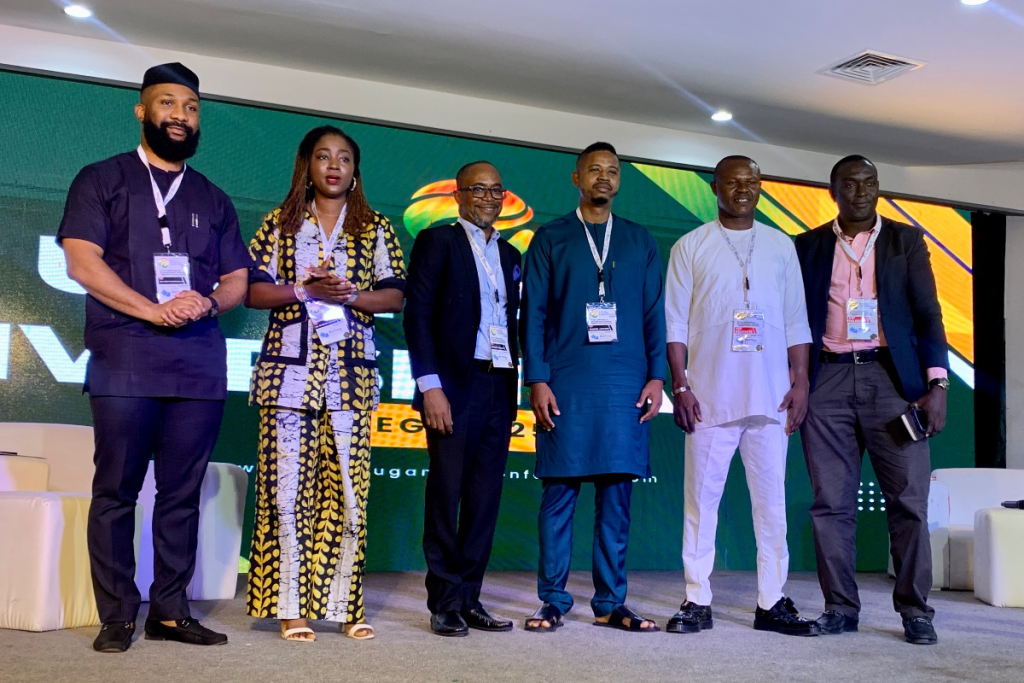
The session was moderated by Peace Ugonma Nwankpa, an iGaming analyst and writer at Find.co. Panellists included Derrick David Kentebe, founder, CEO and executive chairman of YangaGames Technologies Limited; Olaitan Olanrewaju Samuel, business development manager at DalaPay and founder of iBetAfrica; Kelani Opeyemi Mercy, co-founder and lead at iSoftnova Tech Limited; and Oluchi Faith Amadi, a cybersecurity GRC analyst at Privacure, Cybarik Limited.
Trust, Not Talent, Remains a Major Barrier
Kentebe said most Nigerian gaming operators still depend heavily on foreign platform providers, but argued that the situation is driven more by perceptions of reliability, experience and support than by a shortage of local technical talent.
According to him, Nigerian developers are increasingly approaching operators directly, offering technology solutions at significantly lower costs than foreign vendors.
He said the industry is also becoming more willing to discuss local content and technology ownership, although trust remains a major hurdle.
For local developers to win operators’ confidence, Kentebe said, they must demonstrate a strong understanding of regulatory and compliance requirements, including responsible gaming and data protection, from the earliest stages of platform development.
On whether operators should seek complete ownership of their technology platforms, he said there is no universal answer, as the decision depends on an operator’s strategy, financial capacity and long-term objectives.
“You can either rent or you can buy,” he said.
Payments Highlight Africa’s Fragmented Digital Infrastructure
The question of technology ownership also extended to payments.
Samuel said domestic payment infrastructure allows Nigerian operators to process local transactions seamlessly because the underlying rails are located within the country.
However, he noted that the situation becomes more complicated when transactions cross national borders.
Using a transfer to Ghana as an example, he explained that once a transaction leaves Nigeria, it becomes subject to international settlement systems as well as the regulatory requirements of the receiving country.
“When it is crossing the border… we don’t own it. It is never for us,” he said.
Samuel compared Africa’s fragmented payment environment to travelling across shared highways rather than operating on a private road.
He called for African countries to develop common rules for cross-border payments, arguing that greater regional harmonisation would make settlements across the continent faster and more efficient.
The Code Is Not the Hardest Part
Mercy said the technical challenge of building a Nigerian sportsbook or betting platform may be less significant than the challenge of earning the market’s confidence.
She noted that coding is a skill that can be learned, but developing the expertise required to price risk, connect algorithms to betting odds, calculate margins and manage payout mathematics is considerably more complex.
According to her, failures in gaming technology can often be traced not to poor coding but to weaknesses in the mathematical and commercial assumptions underpinning the platform.
She said her company’s work on gaming platforms has also exposed Nigerian developers to some of the mathematical assumptions behind foreign providers’ odds and reporting systems.
That knowledge, she added, gives local teams greater capacity to scrutinise the figures presented to regulators and business partners.
But technical competence alone is not enough.
Mercy said integrity and a proven delivery record are essential if local developers are to persuade operators to abandon established foreign providers.
She cited instances where locally contracted developers were later discovered to be working against the interests of the operators that hired them, reinforcing the need for trust and accountability.
Security: ‘We Are Not Yet Ready to Own It’
The strongest warning came from Amadi, who questioned whether Nigerian operators can claim genuine ownership of their technology if they are unable to adequately protect the personal and financial information entrusted to their platforms.
She pointed to the sensitive information collected by gaming platforms, including bank details and identification numbers, and argued that data protection must be treated as a fundamental part of platform ownership.
Amadi also challenged the assumption that hosting a platform on a major cloud service automatically guarantees adequate security.
She cited a conversation with an unnamed platform founder who regarded hosting on Microsoft Azure as sufficient protection.
According to Amadi, such an approach misunderstands the cloud’s shared-responsibility model. While cloud providers are responsible for securing their infrastructure, organisations remain responsible for protecting the data and systems they operate within that environment.
She warned that iGaming platforms are particularly attractive targets because they combine large volumes of personal and financial information with high transaction activity.
For that reason, she said, cybersecurity must be embedded into the architecture of a platform from the beginning rather than treated as a compliance requirement to be addressed shortly before an audit.
She described the approach as “cyber resilience” — continuous monitoring and security management that allows an organisation to demonstrate its security posture at any point, rather than only when a certification is due for renewal.
“Security and data governance are not a feature of the stack,” she said. “They are a precondition to building the stack.”
Who Should Make the First Move?
Nwankpa then posed a central chicken-and-egg question to the panel: if Nigerian operators are unwilling to risk their licences by deploying locally developed platforms, who should take the first step?
Kentebe said the responsibility rests largely with local developers.
He argued that developers seeking to displace established foreign providers must first prove that they can deliver comparable or superior reliability, technical support and operational performance.
Mercy agreed, noting that local providers entering a market where foreign platforms may already have five to ten years of operating experience face a significant credibility challenge.
Such providers, she said, must demonstrate their capabilities “beyond every doubt” before an operator will be willing to make the switch.
Balancing Speed, Security and Customer Experience
The panel also examined the tension between the pressure to launch quickly and the need to conduct thorough security reviews.
According to a panellist speaking from a risk and compliance perspective, organisations often prioritise rapid onboarding and deposits but underestimate the time required to secure a platform properly.
The panellist cited a case involving a platform vendor that deliberately left out authentication in an attempt to make customer onboarding easier. The security gap was subsequently identified, forcing the vendor to halt operations and rebuild the system before launch.
The lesson, the panellist argued, is that integrating security from the beginning is ultimately faster and less expensive than attempting to retrofit it after deployment.
Another panellist, focusing on payments, said customers expect both instant transactions and strong protection of their personal information.
Operators, therefore, must design systems capable of delivering speed and security simultaneously rather than treating one as a trade-off against the other.
Can Nigeria Own Its iGaming Technology?
When asked to give a one-sentence answer on whether Nigeria can eventually own its iGaming technology, the panellists were broadly optimistic, although they acknowledged significant obstacles.
One panellist stressed that security must be non-negotiable from the beginning of every platform build.
Samuel said Nigeria can develop greater ownership of its iGaming technology, but argued that achieving full ownership will also require cooperation among African markets, particularly in the area of cross-border payments.
Nwankpa closed the session by observing that Nigerian operators currently rent significant portions of their technology stack.
Rather than portraying that dependence as an outright failure, she described it as a deliberate financial and strategic choice.
The panel, she noted, had nevertheless exposed the gaps that must be addressed if Nigeria is to move from building the visible front end of iGaming to owning more of the technological backbone behind the industry.