
Lagos, Nigeria’s commercial hub, has broken into the global Top 100 Sports Cities, ranking 90th in the 2026 Ranking of Sports Cities released Tuesday by global communications firm Burson.
The ranking identifies the 100 cities worldwide most strongly associated with sport, drawing on a combination of stakeholder perceptions, media coverage, social media activity and reputation analysis.
Lagos’ entry places it among five African cities featured in the 2026 global ranking.
Dakar, Senegal, ranked 47th; Cairo, Egypt, 69th; Cape Town, South Africa, 89th; Lagos, Nigeria, 90th; and Rabat, Morocco, 94th.
Dakar recorded the biggest rise in the 2026 ranking, jumping from 80th in 2025 to 47th this year.
The remarkable rise has been linked to the Senegalese capital’s preparations to host the Dakar 2026 Youth Olympic Games, the first Olympic sporting event to be held on African soil. The event has placed Dakar under increased international attention ahead of the Games.
According to Burson, the ranking seeks to measure how cities build global influence through sport by combining stakeholder perceptions with analysis of media, social media and reputation.
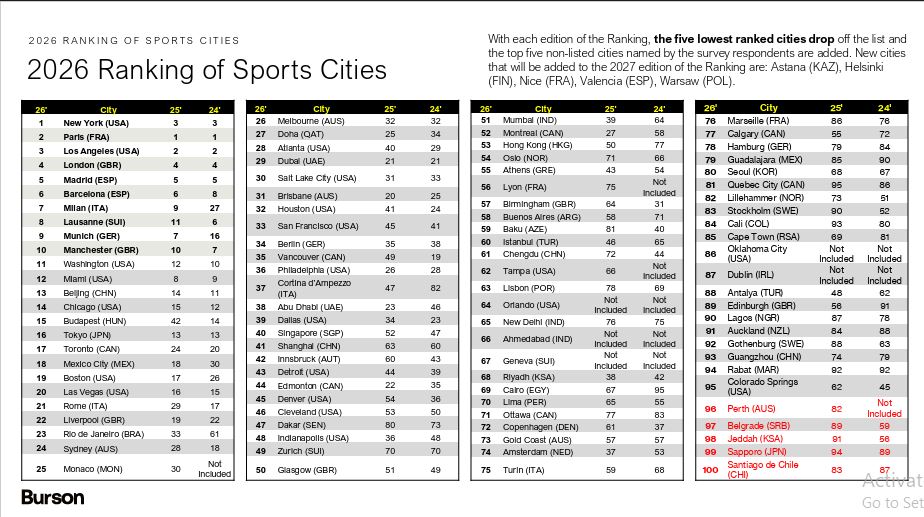
New York Takes No. 1 Spot
At the top of the 2026 ranking is New York City, which has emerged as the world’s leading sports city.
Paris moved into second place after topping the ranking for three consecutive years, while Los Angeles, London and Madrid completed the global Top Five.
New York’s position reflects what Burson described as a landmark sporting year, including the Knicks’ NBA Championship and the FIFA World Cup Final at New York New Jersey Stadium.
Beyond individual events, Burson noted that New York’s strength lies in its year-round sports ecosystem, combining major professional franchises, international competitions and sustained global media attention.
Paris continues to benefit from the international profile and legacy of the Paris 2024 Olympic and Paralympic Games, while Los Angeles is building momentum ahead of its hosting of the 2028 Olympic and Paralympic Games.
London’s global sports profile is driven by its diversified sporting ecosystem, major events, international competitions and global leagues.
Madrid, meanwhile, continues to strengthen its position through its association with one of the world’s most iconic football clubs and its regular hosting of major international sporting events.
What The Ranking Means
Burson said the findings demonstrate that international sports federations and organisations can influence the reputation of cities in ways that extend beyond simply awarding them major sporting events.
Through host-city selection, stakeholder engagement, competition formats and year-round event portfolios, sports organisations can help determine which cities gain international visibility, credibility and long-term standing in global sport.
The ranking is refreshed annually. According to Burson, the five lowest-ranked cities are removed from each edition, while five cities not previously included but identified by survey respondents are added.
The cities set to join the 2027 Ranking of Sports Cities are Astana, Kazakhstan; Helsinki, Finland; Nice, France; Valencia, Spain; and Warsaw, Poland.
How The 2026 Ranking Was Compiled
The 2026 edition covers a measurement period from July 1, 2025, to June 30, 2026.
The period captured the full build-up to and Games period for Milano Cortina 2026, while the FIFA World Cup was still in its early stages when the measurement window closed.
Media and social media coverage were measured throughout the period.
Burson said Brandwatch tracked sport-related mentions of cities across X, Instagram, Facebook, Reddit, blogs and websites, while Muck Rack monitored media articles linking sport with individual cities.
The Ranking of Sports Cities is an initiative of Burson’s Lausanne office, a regional centre of excellence for sport located in the Olympic Capital, where more than 60 international sports federations and organisations are based.
Burson said it works with cities, regions, countries and sports stakeholders to maximise the reputational benefits of hosting major sporting events, including identifying suitable events, supporting competitive bids and developing communications and public relations strategies around major competitions.