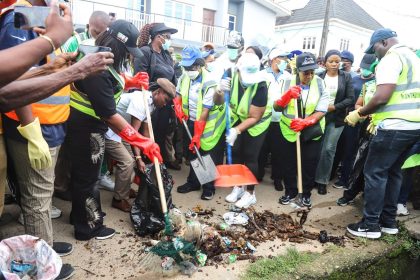

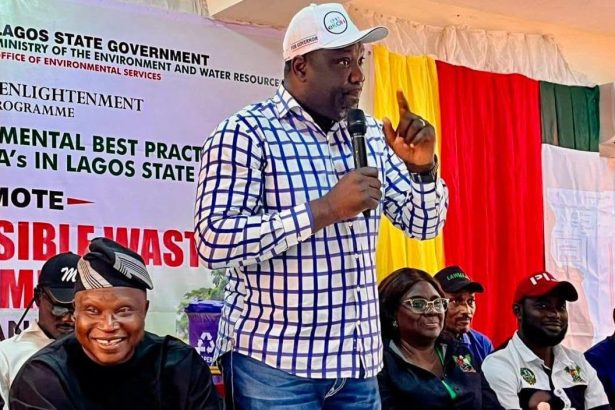
The Lagos State Government on Friday reiterated that achieving a cleaner, healthier, and flood-resilient environment requires the active participation of every resident, stressing that environmental sustainability can only be achieved through collective responsibility and behavioural change.
Speaking while addressing participants at a Stakeholders’ Environmental Enlightenment Campaign held at Amuwo-Odofin Local Government, the Permanent Secretary, Office of Environmental Services, Dr. Gaji Omobolaji
said the campaign forms part of the State Government’s continuous efforts to deepen public awareness and encourage responsible waste management practices across Lagos communities.
Gaji, represented by the Director of the Environmental Assessment Department, Dr. Olasunkanmi Sojinu, explained that the initiative aligns with the vision of Governor Babajide Olusola Sanwo-Olu’s administration to build a cleaner, healthier, safer and more sustainable Lagos through inclusive stakeholder engagement and sustained environmental advocacy.
Gaji noted that Lagos, as Nigeria’s commercial hub and one of Africa’s fastest-growing megacities, generates enormous volumes of waste daily, and the government has continued to invest significantly in waste management infrastructure, drainage maintenance, recycling programmes, environmental sanitation and public enlightenment, adding that the success of these interventions depends largely on residents embracing proper waste disposal habits.
According to him, indiscriminate disposal of refuse remains one of the greatest environmental challenges confronting the state, with waste still being dumped on roads, medians, drainage channels, and other unauthorised locations.
Gaji warned that such practices obstruct drainage systems, contribute to flooding, degrade the environment, endanger public health, and undermine the government’s substantial investments in environmental management.
He stressed that environmental cleanliness is a shared responsibility, noting that while the government will continue to provide infrastructure, formulate policies and enforce environmental laws, residents, businesses, market leaders, transport operators, religious organisations and community associations all have critical roles to play in keeping Lagos clean.
He said the State Government remains committed to promoting voluntary compliance through education, dialogue, and community partnership, explaining that behavioural change remains more sustainable than relying solely on enforcement.
“We would rather educate than prosecute, prevent than penalise and build a culture of environmental responsibility across our communities,” he stated.
The Permanent Secretary disclosed that the government has intensified environmental monitoring, routine sanitation inspections, drainage maintenance, evacuation of waste from illegal dumpsites, and enforcement against environmental offenders.
He mentioned that surveillance has also been strengthened across highways, markets, transport corridors, and identified environmental black spots to discourage indiscriminate waste disposal.
Gaji called on Local Governments and Local Council Development Areas to sustain environmental advocacy at the grassroots by mobilising residents and strengthening community participation.
He also urged traditional institutions, Community Development Associations, market associations, transport unions, the media, and the private sector to continue championing responsible environmental practices within their respective communities.
He advised residents to patronise only approved Private Sector Participation (PSP) waste operators, dispose of waste responsibly, keep drainage channels free of refuse, and promptly report environmental violations through appropriate government channels.
He added that the environmental objectives of the State Government’s THEMES+ Development Agenda can only be realised when residents recognise that environmental responsibility begins with individual actions.
The Permanent Secretary urged participants to become ambassadors of environmental responsibility by promoting proper sanitation and waste management practices within their homes, workplaces, and communities.
He expressed confidence that through sustained collaboration, shared responsibility, and continuous public enlightenment, Lagos would continue to make significant progress towards becoming a cleaner, healthier, and more environmentally sustainable city for present and future generations.
In his welcome address, the Chairman of Amuwo Odofin Local Government Area, Prince Lanre Sanusi, said a clean environment promotes and attracts investment, improves economic productivity and enhances the overall quality of life.
He said environmental sustainability is a shared responsibility of the state, local government, and the Residents, encouraging participants to embrace proper waste management practices and become advocates for environmental responsibility wherever they work and reside.
Participants at the stakeholders’ enlightenment include community leaders, market associations, transport unions, traditional rulers, environmental stakeholders, and residents.